
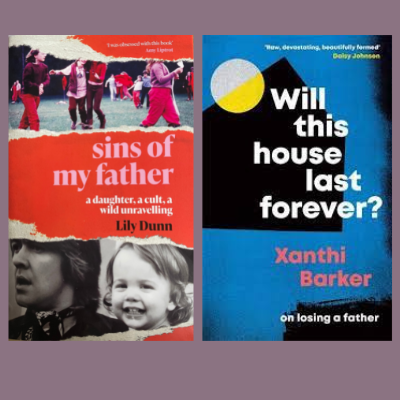
It is very strange to read a book that speaks so closely to your own experience. Xanthi Barker wrote a memoir about her enduring love for her poet father, Will This House Last Forever? I saw the review in the Guardian a year or so ago when it was first published and had a number of thoughts at the same time: the main two being, this book looks interesting… I’m not sure I can read that! But I don’t think I had a publishing deal for my memoir at that point, and I was in that horrible stage of fear that someone else was going to publish my book before me. An irrational moment of madness, of course, because how can two memoirs be the same? But anyone who has experienced that pre-sale-state-of-anxiety knows that seeing a book that is similar in subject matter to yours is first and foremost a stab in the neck, before it evolves into a more natural state of generous curiosity.
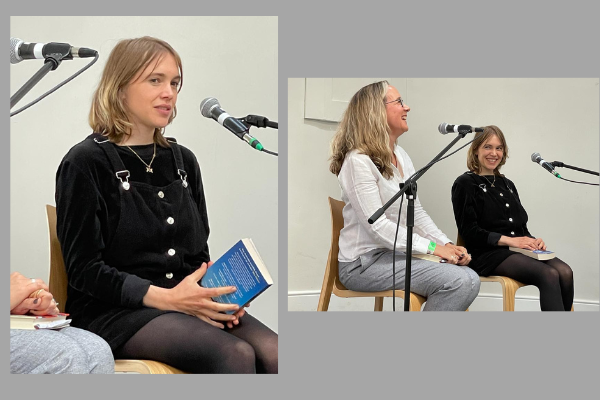
What I know now, having devoured the book over a few days when told by Stoke Newington Festival that Xanthi and I would be paired up for discussion, is that there is plenty of room in the world for both Xanthi’s book and mine, and the power of these memoirs is in their similarity, and how much they also compliment each other. If you are even vaguely interested in psychology, and dysfunctional family dynamics, and you have time to read the two books closely together, you will be struck by the extraordinarily similar psychic patterns that manifest themselves in neglected daughters of selfish, addicted, distracted fathers, but also how differently such a fundamentally similar story can be told.
There is so much beautiful imagery in Xanthi’s book: the pile of rocks that her father decides to build into a house in Greece, to create a home where he can write; the holidays she and her brother spend in this same house, throwing together meals from out of date cans left dusty in the cupboards, while their father talks and drinks, drinks and talks – until both eventually dry out; the times she and her father connect, and the rude awakenings that he might not be as seductive as she had always imagined. But mostly I connected to the times she is left wanting and longing, missing him and trying to understand that mostly one-sided and painful love.
There were whole passages I marked that echoed so much of my experience. All those years of wanting to please, wanting to write yourself into your absent parent’s life, and then later, once he’d died, that realisation that the same patterns of restlessness had somehow seeped, like acrid wine, through the fabric of your shirt. No man was good enough. But how could this be, when the man we both so longed for was so disinterested in us? No man inspired such intensity of feeling, perhaps. The man we both yearned for was a father ‘who did almost anything he could to avoid spending time with me when he was alive’ writes Xanthi. How sad that in those long years of grief on some unconscious level, we both were trying to replicate this destructive love. When Xanthi and I spoke on the phone prior to the event at the festival, she suggested, ‘we both suffered a kind of pseudo romanticism’. It was romanticism for an impossible man.
But both books are very different. Xanthi writes and speaks like a poet. She has a lovely turn of phrase and ease with which she strings together words. In my notebook while speaking on the phone, I wrote ‘nurturing your own private perfect’ as something Xanthi said in response to my suggestion that we had both felt a kind of possessiveness for our love of our fathers. Xanthi’s book is also written very much from within the experience of longing, and of loss, whereas mine has a more detached quality, from years of reading around my subject and reflecting, redrafting. I thought about this and wondered at my need to control my narrative. Had I not felt fully safe to approach it in a more immediate way? Was I scared of exposing the rawness of my pain, because the betrayal had gone too deep? Or maybe that detachment has come with enough distance from the source of that pain; it has come with a kind of closure too.
Or maybe this is simply two women exploring not only their formative relationship with the first man to touch their lives, but also their writing voice. It was such a pleasure to share the stage with Xanthi.
You can buy Will This House Last Forever? here:
And Sins of My Father, here:
0 Comments