
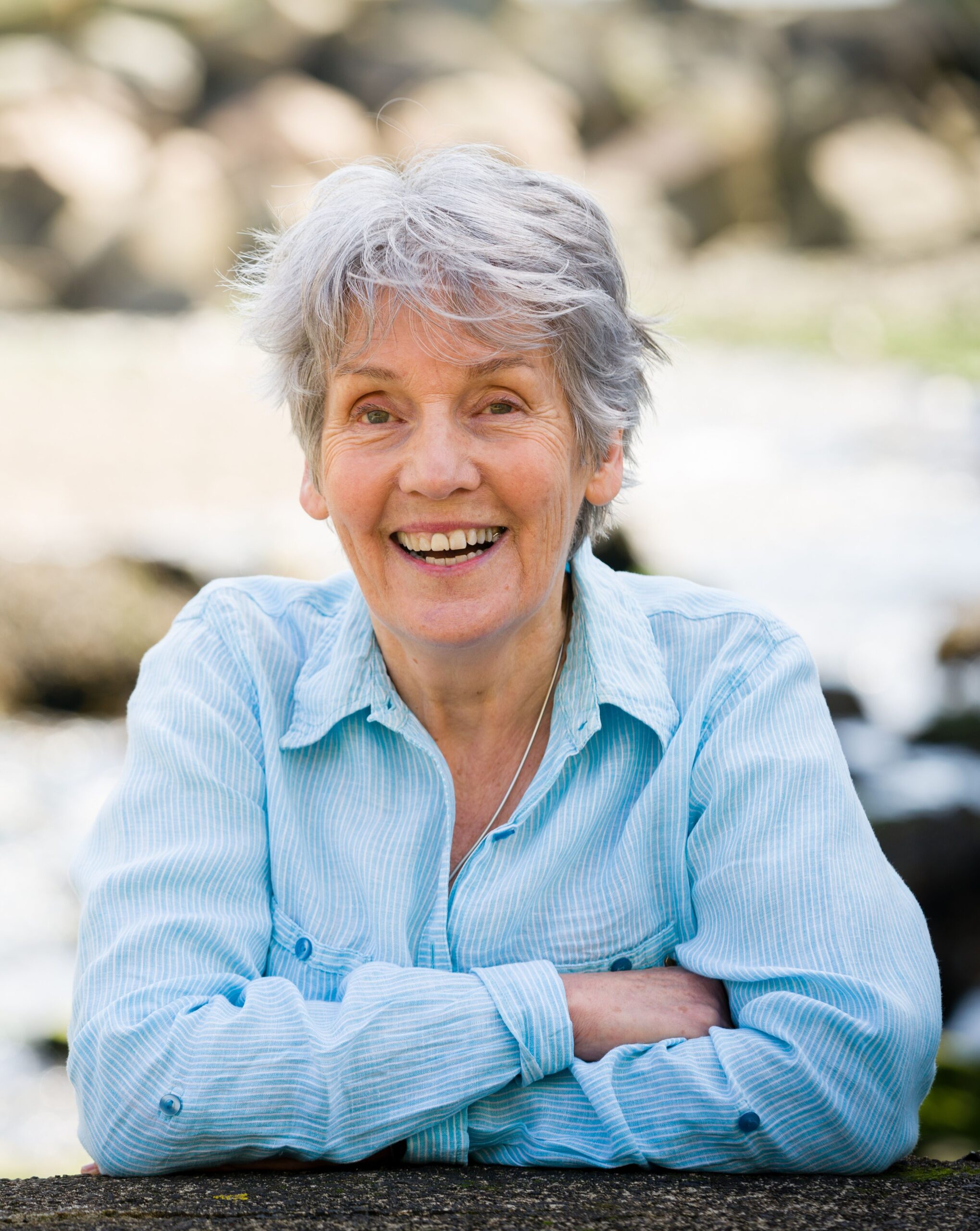
 In this series of interviews, I will be talking to memoirists, both published and working towards publication, about their writing process, and how writing memoir has helped them better understand themselves and their place in the world. I am also interested in how a writer navigates difficult territory for themselves and those they love. As well as featuring the interviews here on my blog site, I will be using them as research for my upcoming publication, INTO BEING: The Radical Craft of Memoir and its Power to Transform (published by MUP in 2025).
My 18th interview is with Mary J Oliver, whose book about her father, Jim Neat is a hybrid of memoir, poetry, fiction and biography, and a fine example of the piecing together of a man’s life from artefacts: diary entries, letters, documents, photos and drawings. It is a triumph in selection, and how much blank spaces also speak.
Mary J. Oliver taught Fine Art at Falmouth University and exhibited widely in UK, before making her debut as a writer, with Jim Neat, in 2019 (published by Seren). Five poems from the text were set to music for piano by Cornish composer, Judith Bailey. And soon afterwards, it was adapted as a film script and as a stage play. She is currently working on a memoir. She has also returned to her visual practice, and focuses on working collaboratively with others, exploring the integration of text and image. She enjoys sharing what she’s learnt along the way and is available for mentoring via her website. Details of her artwork and Jim Neat, can be found at www.maryjoliver.com
When and how did you realise you had to write Jim Neat?
Although Jim Neat was my father, I knew next to nothing about him. It wasn’t until I was in my sixties, when a disturbing family incident led me to wonder who he’d been. I suddenly felt the need for a Dad, and realized with some shock that I’d never really had one, that he and I had somehow always been on the edge of the family. My recollection of him was little more than a dusty figure against a chalky background. Why had he been so isolated within the family? Why was he so silent and invisible? So disconnected? How could he have lived in the same house as me and been so utterly absent?
Seeking answers to these questions was how the book started, though I had no idea that the research I undertook would lead, ten years later, to publication. I was an artist, not a writer, just wanting to know who this mysterious figure in my life had been.
The first notes I made were simply fragments of childhood memories, including brief snatches of exchanges between my parents that had meant little to me at the time but were clearly significant in retrospect. I followed this up by contacting my cousin, Sally. She produced from her attic a plastic carrier bag, containing letters that Jim had written to her mother, his favourite sister. The intimate details and dramatic events revealed in these letters were mind-blowing for me, and indicated that, if I were to further unpack his story, I’d need to understand their historical context. Thus my research expanded. I was hooked.
Did it start with an image, or an emotion, or first line, or an idea – or none of the above?
One of the few facts I remembered my mother telling me about my father was that in Canada, as a young man, he’d had a passionate relationship with a Ukrainian woman who’d died giving birth to their daughter. The first specific idea I had for the story was to tell it from her point of view. This felt liberating; if anyone could give him a life, she could. Although she died tragically young, they must have had some great times together; I very much wanted him to have had that joy early on in his life, because I never saw him experience any joy in my lifetime. I’d give her licence to tell all.
However, as the story became more complex, I veered away from that plan and the final version evolved into a collage of viewpoints. That initial idea, though, remained influential in the way I curated and structured the book. It’s his story, told in the voices of the people he met on his awesome journey.
Did it feel essential that you do it? Was the need urgent? Persistent?
Oh yes – and it was triggered by the family incident referred to. It was an appalling, illegal act – that I chose not to contest. I won’t give details here for obvious reasons, but that was when I had the childish thought, ‘where’s my Dad?’, as if, at a time like this, a father-figure should be around to ensure fair play. That query entrenched itself in my head.
In times of stress, I’ve always found relief in work; in this case, the creative instinct kicked in pretty damned quick and within days I’d determined to make a work of art out of my father’s mysterious life, out of his absence. Starting with the tiniest fragments, I was going to find out who he was, give him a voice and I set out on the long journey to find him.
It fully occupied me for ten years. Roughly five years of research, five years of distillation and structuring. On the cross-trainer at the gym, I’d be augmenting my research by imagining back-stories for peripheral characters; dreaming up ways of describing dust storms in the prairies; wondering what it must have been like for Jim, working as a lumberjack in North Saskatchewan, to discover that his work-horse’s eyeballs had frozen solid overnight. I must have been pretty weird to live with. Finally, I took a lone trip across Canada in his footsteps, to get a feel for the weather and the terrain, and to trace my half-sister, the daughter he’d been forced to abandon there in 1936.
How does memoir differ from writing poetry or fiction?
I used both poetry and fiction in ‘Jim Neat’, and they played different roles. It felt natural to condense my childhood memories into poetry, using the first person present tense. I also used poetry to recast large amounts of research. It was an excellent way of cutting to the chase, omitting unnecessary detail that had seemed relevant and fascinating at the time, but actually distracted from the story’s energy. I am grateful to poet Penelope Shuttle for encouraging me to do this.
The book acquired these hybrid characteristics early on in its development. I also exploited the range of material that was becoming available to me, archival documents that provided evidence of my father’s activities; passenger lists from Atlantic crossings, prison records, hospital case notes, letters, diaries, postcards, photographs. They gave the pages a visual quality and I loved the challenge of finding ways to weave them into the text.
The fragmentary appearance that emerged was something I wanted to retain, because it reflected most accurately the essence of memory. But at the same time, I needed to create a sense of continuity and find a cohesive shape for the story. I’d print out sections of the manuscript, lay them on the floor and explore the endless permutations. I began also to use powerful dreams that I was having, and to imagine and fictionalise aspects of the narrative, elements which induced a sense of flow.
What is it about memoir that appeals to you?
I have to say, memoir had no particular appeal for me when I was writing ‘Jim Neat’. I didn’t consider myself to be writing one, and it didn’t occur to me to read memoir for inspiration or guidance.
When it dawned on me that my project might be of interest to others, I did think I’d better hone my writing skills, but it was poetry I was drawn to. I hadn’t read a great deal of poetry, but saw it as the essence of concise writing, and that’s what I wanted, to create a distilled version of my research and imagination. I joined poetry groups, attended courses and had to get a new bookcase to accommodate the contemporary poetry books I was suddenly devouring.
Feedback on my poems was positive, so I submitted some to competitions and journals. Several were published, encouraging me to submit an early draft of the story to The Welsh Review Short Story Competition. I received a phone call, and was asked if Jim Neat was a real person. I assured them he was, and my submission was promptly transferred to the Memoir section of the competition – and won 2nd prize (a writer’s retreat at Ty Newyth Writing Centre). I didn’t argue but in my mind the story still wasn’t a memoir, it was just a personal attempt to create a father-figure, simply because I wanted one.
The version that Seren accepted for publication stopped at the point when I was conceived in 1945, the afternoon my Dad returned from the war. But the editor asked for more; he wanted the book to include my journey too; the process of the unearthing of my father. I had zero interest in writing a book about me, so it was with some reluctance, I added Part 3, which refers to my childhood, and to the journal I kept on the trip across Canada.
This final version was published in 2019 and I was gob-smacked by the response, especially by adaptations submitted to me by Gabrielle Finnegin, (a stage play, ‘My Father’s Daughter’) and Veslemoy Stavdahl, (an artfilm, ‘The Worker’s Body’). The next three years were taken up working with teams on these productions, a very different existence for me from that of reclusive writer. At the moment they’re on temporary hold because of a threat of disruption and legal action if they go ahead (a crazy man without a leg to stand on). Meanwhile, a fantastic rehearsed reading of the stage play took place to a full-house at the Theatre Royal Bath, as planned and full productions will go ahead when the time’s right.
I’m very encouraged to still hear regularly from readers who are inspired by the book to explore their own complex family dynamics creatively and constructively. Recently, a poet friend, Nancy Mattson, drew my attention to ‘The Missing List’, Clare Best’s ground-breaking memoir in which she breaks the silence that had been imposed on her since early childhood. It led me to realize that, in spite of the book I’d written, I too have been silenced all my life. I see now that all my creative work, my writing and my visual art, has been preoccupied with the uncanny qualities of both silence and absence. In ‘Jim Neat’, I knew I’d succeeded in giving my father a voice but I didn’t realize I hadn’t actually found my own. It’s as if I have been absent from my own life; a silenced person doesn’t truly exist. Arundhati Roy says, ‘There’s really no such thing as ‘the voiceless’. There are only the deliberately silenced or the preferably unheard’.
In the last year, I’ve tuned into the true meaning and value of memoir. It was both sobering and inspiring to discover Lily Dunn’s work on memoir and to read Camille Kouchner, Rebecca Watson and Vanessa Springora, contemporary women writers prepared to describe, in unprecedented ways, trauma they’d experienced in childhood. And, even more significantly, the impact those events have had on the rest of their lives. The risks they took in exposing the tyranny of their abuser is heroic and a significant turning point in the refusal of women to be silenced. Transforming trauma and its aftermath into art and being heard at last, is a powerful tool with which to confront this scourge in society.
Were there aspects of your story that you resisted, that you thought you could get away with not writing, but then realised it wasn’t possible – and if so, how did you protect yourself, or how did it feel to write those sections?
Yes, there was an aspect of the story that I didn’t reveal, because withholding it was instinctive to me, and had been for my whole life, or at least since I learned to speak at the age of two or three.
In the early stages of writing the book, I had explored it marginally and benefitted therapeutically from that. But, as it involved another member of the family, once I realized that publication was a possibility, I edited it out. I’d always intended the focus to be my father, not myself or any other family member. Acknowledging those parts of my life had been an essential part of the process, but not one that I intended to retain.
And the value of that process was that it gave me an understanding of my family, why it was as it was; this, in turn, filled me with love for them all. I felt content in a way I’d never experienced before and I was confident that the family would love the story I’d woven around our past. And they did. Their public reviews, private comments and emails were unanimously complimentary.
Was it a process to become ‘ready’ or ‘prepared’ to go to the places that you might have otherwise resisted?
I was neither ready, nor interested, to go to those places publicly. But, five years after publication of ‘Jim Neat’, everything’s changed. I’m in a different place now.
Does writing memoir offer cohesion to otherwise fractured memories and experience, and is that cohesion empowering? If so, expand on why?
Yes, it does. And it is. But in my case, ‘Jim Neat’ was like a trial run. It was only the beginning. I created a father figure for myself, that I feel is emotionally true to him, and I’m happy that I gave him a voice – it was like giving him his life back.
I recently visited my older brother in Canada. He and his extended family arranged for me to read from ‘Jim Neat’ in their local library. My Dad spent half his life drifting in and out of libraries, seeking shelter and education. It must have been poignant for him, I think, to look down and see his descendents celebrating his wayward life in a library on Vancouver Island where it all kicked off a hundred years ago. As for me, it was an occasion of affirmation way beyond my dreams.
Thank you for this illuminating interview with Mary Oliver, a good friend who alerted me to your blog. I will be reading your other interviews — and your own book! A circle of memoirists that includes another friend, Clare Best, might eventually include me. I have another book of poems to finish first…
Hi Nancy, Thank you for your comment! And so pleased you’re enjoying the blog. Hope you find some inspiration from some other interviews here. And good luck with your writing.
Good luck, Nancy, with your current book of poems and with your memoir that has been quite a long time coming! It will be poetic and fantastic and I look forward to reading it – as well as reading about it, here.
The interview gives me such a sense of the layering process, both psychologically, emotively and the intense physicality of the documented. An assemblage of interconnecting stuff for the author through her father’s lived life.
Thank you Alan. It is so interesting, isn’t it?
Thanks for your comments, Alan. That layering process felt organic and was almost unconscious at the time, seeming to be the only way to arrive at my destination. It’s interesting to look back at it now, and see it through the insightful perceptions of others. Thank you.
Mary, this memoir emerges as a kind of psychic restorative, a narrative reassembly of the self. Writing a memoir is akin to resurrecting past demons and transforming them, turning shame into text, ambiguity into narrative, and isolation into shared history. The result is not just cohesion but also reclamation. As the author of “Jim Neat” discovers, writing can be an act of giving voice, a form of necromancy that breathes life into fractured histories and scattered memories. Through the memoir, one creates a palimpsest over colonial narratives, refusing to be defined by forces that diminish the self. It assembles a patchwork of familial lineages and past wanderings, not from a position of victimhood, but as a survivor, celebrating the contradictions and complexities that shape a life. When a fractured memory gains narrative form, the past—once a disjointed echo—becomes a sonorous, resonant presence that enriches rather than simply haunts. This process is empowering because it restores agency over one’s story and claims ownership of history, allowing once-sidelined voices to assert themselves within the world’s polyphony. In our dystopian modern era of misinformation and a cult of personality, the memoir carries the risk of becoming a fetish, a means of self-soothing that lacks real impact. It emphasizes that the act of writing should not be an endpoint but rather a springboard for broader engagement and understanding. Even amidst self-discovery, the memoirist must not overlook the larger dynamics of power at play, as you has successfully navigated through writing and promoting its thesis. In this dance between inner revelation and outer critique, writing becomes both a personal and political act. The “Jim Neat” reading in a library illustrates how revisiting and vocalizing family narratives can serve as a moment of collective affirmation. In this way, memoir transforms personal stories into both tribute and testimony, signalling that the past, when embraced in all its fractures and fragments rather than demonized, can be an enduring source of strength and renewal. I find myself eager to know what happens next. I await the sibling to this text—the challenging second book.
This is beautiful and so well put. Thank you. I will pass on to Mary.
Thank you for your insights, Salma. I am encouraged by your comment that writing memoir should not be an end-point but rather a spring-board for broader engagement and understanding.