
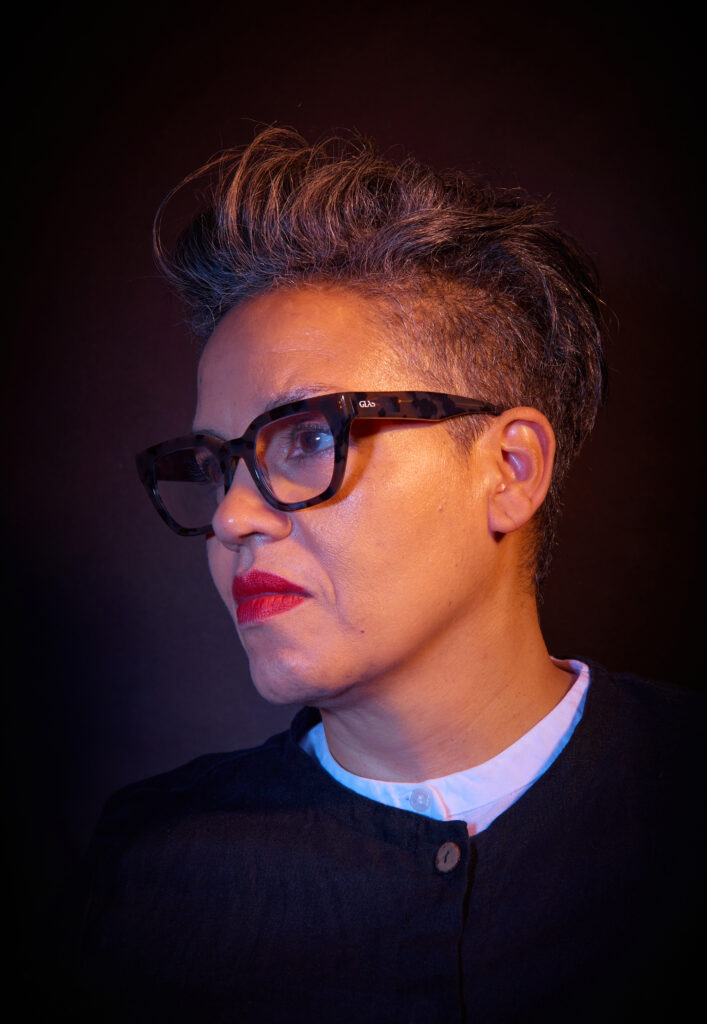
Photo by Paul Crowther
In this series of interviews, I will be talking to memoirists, both published and working towards publication, about their writing process, and how writing memoir has helped them better understand themselves and their place in the world. I am also interested in how a writer navigates difficult territory for themselves and those they love. As well as featuring the interviews here on my blog site, I will be using them as research for my upcoming publication, INTO BEING: The Radical Craft of Memoir and its Power to Transform (published by MUP in 2025).
My eighth interview is with Kit de Waal, whose memoir Without Warning and Only Sometimes is a vivid and compelling account of growing up in a Jehovah Witness family in a bohemian enclave of Birmingham, full of humour and wisdom. Kit de Waal, born to an Irish mother and Caribbean father, was brought up among the Irish community of Birmingham in the ‘60s and ‘70s. Her debut novel My Name Is Leon was an international bestseller, shortlisted for the Costa First Novel Award, longlisted for the Desmond Elliott Prize and won the Kerry Group Irish Novel of the Year Award for 2017. In 2022 it was adapted for television by the BBC. Her second novel, The Trick to Time, was longlisted for the Women’s Prize and her young adult novel Becoming Dinah was shortlisted for the Carnegie CLIP Award 2020. A collection of short stories, Supporting Cast was published in 2020. An anthology of working-class memoir, Common People was crowdfunded and edited by Kit in 2019. Kit founded her own TV production company, Portopia Productions and the Big Book Weekend, a free digital literary festival in 2020 and was named the FutureBook Person of the Year 2019. She is a patron of Prisoners Abroad, ambassador of Well-being in the Arts and a trustee of The Reading Agency. Kit is a Fellow of the Royal Society of Literature and Professor and Jean Humphreys Writer in Residence at Leicester University. Her memoir Without Warning and Only Sometimes was published in August 2022.
What made you want to write a memoir?
I was literarily persuaded to do it. I had no desire to write it until I was offered money. Then suddenly I had the desire and became quite excited by the prospect. But I had never considered writing a memoir before.
Why did you not consider it? Were you resistant to it?
No, not at all resistant. I didn’t feel I had anything to hide or there was anything I hadn’t already confronted. I just didn’t think I was particularly interesting. Why would I write a memoir? I didn’t consider it mostly because I think I’m quite boring. How could I make it interesting?
Did the process of writing make it more interesting? For instance, exploring memory and seeing where it was taking you?
No, I am one of five children and the five of us have endlessly explored our childhood, so when I decided I was going to write a memoir I knew when it would stop. It stopped when I was in control of my life. Until I was in control of my life my story was interesting because it was weird, but when I got a handle of my life and decided to direct it, things get boring. I quite like boring.
The book covers what I consider my childhood – which is made up of two parts: aged one to 16; and 16 to 21. But me and my siblings have endlessly talked about episodes from our childhood, so me deciding to write a memoir, was more about deciding which of the stories should I write about? There was no excavation to be done, no questioning because we had all done this so many times over the years. So it was a case of extracting the funniest or the most poignant or the most prescient, or the most typical scenes from a big fat list.
You’d done your research because you’d had those conversations with your siblings, so was it a case of merging all your stories? Or did you have to extract your story from the mass story, the communal story?
Yes, it was a communal story, although definitely the memoir was my story. Even though my sisters and brothers are in 99 % of the scenes, it is definitely my version of what happened.
Did you find when you came to write the book your siblings were okay about you writing about your shared history?
I got their permission before I started writing. I would never have done it without their permission even before I started and they said yes. And when I finished, they read it before anyone else and they had the power of veto over everything.
If one of my brothers or sisters said I don’t like that. Or that didn’t happen, it would have come out. No negotiation whatsoever. When I sent them the manuscript, I said this in the email. Here it is, this is what is going to be published, you have the power of veto over any chapter, scene, line or word – if you don’t like it, it comes out. It’s their history, and what I am fine with being out in the world is not necessarily what they are happy with being out in the world.
Did they ask you to get rid of anything?
No. I had one sister who didn’t like two words. That was it. She said I don’t like those two words, so out they came. But in conversations they’d say, aren’t you going to say this? What about that? And I didn’t have the space to put everything in. So the input from them was much more like – how could you have remembered that scene so perfectly and there was a lot of laughter at remembering things, and discussion over what had happened.
When the book was published, was it weird to have strangers read it or family friends read it and make comments? Did this bring up additional challenges with your siblings or were they fine with that too?
They were fine with that. But I do remember going to Manchester Literary Festival with my brother, and he was surprised at the interviewer being so negative towards our father. She had understood our dad as an aggressive, selfish, vain black man. But there was much more to him in the book and in real life. It was interesting to observe someone reading into our childhood in a particular way, putting their stuff on it.
With memoir there is nowhere to hide. If it’s fiction, you can say, it’s a character. It might have been inspired by real life but it’s not real. There’s a directness that is harder to deal with. How has it differed from writing fiction? Was it more difficult to find your voice, for instance?
I had no difficulties at all. I don’t write a lot of fiction in the first person, so that was slightly different. It was so easy compared to fiction. I didn’t have to make anything up. The joy of not having to find the plot!
Had it been cooking? It was there under the surface, a story that had already been formed.
It was a story that had already been formed and I didn’t have to make anything up, but I also didn’t have to explain anything. I wasn’t into justifying or explaining. It was very much a case of here it is, this is what happened. I wanted the reader to experience it as I experienced it as a child, and I didn’t add any adult wisdom. At the time, I didn’t know what was going to happen in the future. As far as I understood it as a child my black nana was a constant. I didn’t know that she would later die. And I wanted my reader to experience it in this way too.
So, it was the process of putting yourself very much in the moment. Was it cathartic in any way? Was it liberating to go back into those memories?
There was no after effect. I put that down to my brothers and sisters and how much we had spoken about it already. I think though that I could have written three memoirs, or a memoir three times as long. I’m giving this version of my mum and dad without the other things, and I was very keen to be fair to them. They were useless parents, but I was really keen to not say I had useless parents because they were so much more than that.
Did it bring up opportunities to discuss your parents with your siblings. You might have written a scene and then gone back to your siblings and asked – was she like that?
There is barely a month that goes by when we don’t have a conversation about our parents. We have always had these conversations and are still having these conversations, despite the memoir. We’re still excavating the past and still making sense of who we are in the moment. I don’t think the memoir impacted that at all. But I do think that’s unusual. It hasn’t deepened anything or crystallised anything. No one else had our childhood. It was not typical of anyone I know. The 1960s. Jehovah witnesses. Father from St Kitts. Irish mother. Poor, very intelligent, living in a middle-class area. I know lots of mixed-race people growing up who live in a different area, or I know lots of Jehovah witnesses who weren’t black. So the only people who are going to understand what we went through, and what we battle with, are one another, which is why we come together to speak about it. Not in an arranged way, it happens very haphazardly.
Has the memoir become part of that conversation? A different way to express things than verbally, and because you’re a writer you were given that privilege to do it that particular way?
For me it’s the opposite. It’s negligible. My brothers and sister don’t talk about it with me. The reality is so much stronger than the book. So much more powerful and present. Imagine if someone had to write the complete works of Shakespeare in 500 words, no one is going to take it seriously and say it covers everything. The memoir is like that. I have 21 years of scenes that I had to choose from. Imagine there are 2 million, and I chose 20. For every chapter I wrote, I could have written an opposite chapter. If I write a chapter about my dad being mean, I can also write a chapter about him being generous. There are 40 versions my childhood and I chose this one. It’s a true version but there are other true versions, too.
That’s so interesting and in a way, it takes the power out of it. Many students are frightened of getting their memoir published and how their families will receive it. There is so much worry around this, and actually what you say puts it in perspective. That it is not life. It is a story. It is not reality, and life continues and life is so much more important that this one particular book.
Absolutely, and you will never ever get it all down. There is no absolute truth with a line around it, there are versions which overlap and contradict and are negated by something that happened the next day or the next moment. It is just a version you choose to write on that particular day, and it has no power unless you say this is the definitive version. It’s like something in the wind. It’s like saying, what’s your favourite meal. It might be fish and chips, but hang on… it’s also steak and kidney pie… but hang on, what about Thai food? There’s a menu of different things to choose from, it’s only what you chose today.
Do you think you’ll ever return to personal narrative or memoir?
No. I’ve got nothing else to say. I am so boring. I don’t do anything. I go to Tesco. I garden. I make jam, badly. There’s nothing interesting.
What is the joy you find in fiction?
I like words, and writing good words. I love slow stories, and fashioning small stories in a small world. A terraced house in Stoke on Trent where mum is a cleaner and dad is a plumber. But within that terraced house there are big stakes. There are undercurrents. Things left unsaid. There are arguments and hopes and dreams. That’s what fascinates me. For me, writing fiction is getting under the normality of that, so that the small stakes about can we buy our son a bike, becomes a whole book because the world is in there. I love that.
How do you think your lived life has influenced the stories you want to tell?
Using that example. My lived life from the outside, looked weird, but no one could have understood the weirdness. Big stakes in a small world. I am endlessly fascinated by the ordinary and people who are overlooked. The people not talking in a room, why are they not talking? Why are they standing over there by themselves? Who is the quiet person, or the square person or the person who doesn’t fit in? That was me. I am not the most interesting person in my family, by far. I am interested in what people call misfits – and I don’t like that word – but that was me. This is what influences my fiction..
You use your own life experience as an inspiration but you write about something other, something external.
Yes, I’ve done my childhood. From 21 to 63, which is what I am now. What on earth would I say? I went to the seaside and brought a house. I could make it interesting. It’s nice to take the experiences I’ve had and the feelings I’ve had and then reimagine the world.
Thank you, so interesting and natural.
Love Ms de Waal’s writings.
One day I hope to hear her speak in person.