
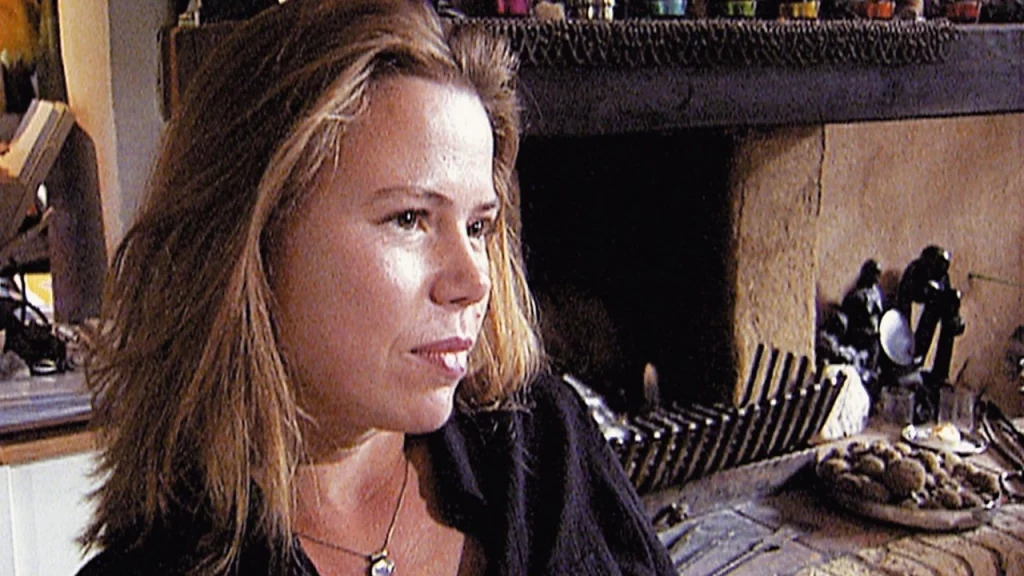
 A friend, Maroesja, recently told me a story. One afternoon, aged 17, she was standing on a train platform returning home from her boyfriend’s, when a man climbed on to the tracks. From down below, he locked eyes with hers. She frowned towards him, squinting, wondering why he was staring so intently, and the world held its breath as everything stilled – just her, a beautiful girl on the platform, and a man wanting her attention, her eyes on him. The train came in like a flash of light and it hit him with such force that he died immediately. ‘His body shattered into a million little pieces, thrown up in the air like rain,’ – like dust, like particles, fractured pieces of hair, teeth and flesh, a thumb here, a fingertip there. And Maroesja had seen it all. She told me this story when we sat in an outside café in Museumplein when I visited her in Amsterdam to start filming a documentary she is making. When I returned home, this image still haunting me, I realised this man had locked his eyes with hers because he had needed to be seen. He had made her his witness.
Earlier this year, my memoir about my relationship with my late father, Sins of My Father, was published (W&N). It follows his life, a kind of biography but also an interrogation of his choice to leave his family in 1979 to join a religious cult led by Bhagwan Shree Rajneesh from his ashram in India, where people traded in their clothes for red robes and lungis, giving themselves over to a quest for enlightenment through love, meditation and free sex. It also questions his many betrayals of us, his family, and how so much success and wealth could have ended in dereliction and death by addiction. I hadn’t fully anticipated the consequences of putting my story out there, one that had followed me around my entire life like a pesky ghost, but I was given some wise advice from a fellow writer – ‘look after yourself around the time of publication, because it will bring up stuff for people which they will want to share with you.’ Mostly, those people have reached out because they, like me, had parents who left the conventions of job, mortgage and family to join the wandering tribe of hippies on a search for something more profound, with no real care for their children who were either dragged along with them or left behind.
But the book has also caused hurt, and at times I have questioned why I wrote it. Why I felt so compelled to put my personal life and that of someone close to me on the page for all to read. Why do any of us write memoir or personal narrative? Perhaps it is a selfish act, but then again perhaps it is not.
This weekend I received a message from a woman who grew up a disciple of Bhagwan, ‘You have helped more people than you realise,’ she wrote. ‘Did you ever feel that you were writing for more than just yourself? There were so many of us left behind and forgotten.’ This person, like many of my generation, experienced the fallout of their parents’ quest for self-realisation, and their belief, encouraged by their guru, that the communes would be a better parent than they themselves could ever be. But this – it has transpired – was an idealistic dream of a madman. Not only misguided, but also dangerous.
Those who have watched the Netflix documentary, Wild Wild Country, will know of Rajneeshpuram, the massive city in Oregon wild country built by disciples, where they landed when they’d outgrown the Indian ashram. How the movement heated up in those years, under the active leadership of Bhagwan’s secretary Sheela, to a boiling pot of paranoia, and conflict not just with the local Oregonians, but the FBI after Sheela and her entourage were hunted down for what was to be the first bio terrorist attack on US soil (they attempted to poison the Oregonians to manipulate votes), and Bhagwan himself for mass immigration fraud, through faked arranged marriages.
But it is not this that I am concerned with. More simply, it is the kids who became the collateral damage of their parents’ choices, to sell their homes and possessions to give large sums of money to the community, to take them out of conventional education, to leave them uncared for, which exposed too many vulnerable minors to predators. Many of these children lost their futures, any glimmer of inheritance, and some, like me, lost a parent. I have heard of many, mainly fathers, who ended up with similar fates to my dad, battling addiction and delusions, isolated from the world in their determination that their love for their guru was right. But isn’t this the result of denial, and resistance to the shame of having got it so catastrophically wrong?
Maroesja was one of these children. We met during the pandemic when I was researching a new book, in which I wanted to capture the voices of the kids from that time, tracking them down in the US, in Denmark, in the Netherlands, to interview them. I fell upon a documentary Maroesja made about her life, Communekind ‘Child of the Commune’, following her mother to Poona, and becoming a disciple aged six. She had wanted to name her film, ‘Children’ of the Commune, and to include the story of the other kids, some of whom were her friends, just as I was attempting to do so 20 years later, but the ex kids would not speak. So she had no choice but to make the film solely about herself.
It went viral, sold to 12 countries, screened at five festivals, and won three awards, with millions of viewers worldwide, and Maroesja was commissioned to write De Droom Van Mijn Moeder (My Mother’s Dream), a book about her experience. Suddenly she was in all the national newspapers, and her story burst into the mainstream – one of having to give up her home and her toys, her school, to live in communities chosen by her mother, where she was undermined and ignored, then groomed and continually hit on by men double her age. Aged 13 she was sent away to a commune in the UK (Medina where my father lived in 1981) where she was set to work in the kitchen, with no schooling.
One of the main belief systems promoted by the cult was ‘you are responsible only for yourself. If you feel happy or sad it is your choice. It has nothing to do with me.’ A convenient get-out card for an adult fooling around, but criminal to a confused and hurting child. With no empathetic witness, Maroesja, like so many of these children, will have questioned the validity of her pain and buried her hurt. Yet now that the film was out in the public domain, it was not her who was blamed for what had been deemed ‘negative feelings’, it was her mother who was held up as a pariah. In the film when confronted by her daughter, her mother was seen to deny responsibility, not directly acknowledging the effects of her selfishness. This deflection was familiar to me, as my father had done the same.
Maroesja and I started a long-distant friendship, texting almost daily and regular zoom calls. Since making her film, she’d had a child and, as a single mother, her creative energy was focused on raising her. But now with a teenager, Maroesja was starting to look outwards again, and asking – what now? I encouraged her to write again and suggested craft books on memoir, and we talked about our joint frustrations of wanting to support those voices that could not speak, of finding a way of sharing their stories, and the obstructions we’d repeatedly been met with. We knew there was a culture of predation within the communes – I had tentatively glimpsed at it in an essay I wrote for Aeon magazine in 2019, ‘The Lost Children’, but it was also still unspeakable, hanging in the air like pollution when I interviewed the ex kids. It was becoming increasingly difficult to write about the experience of the cult without acknowledging the whole truth.
Then something extraordinary happened – the ex kids started talking about it in closed groups on Facebook, and like flood gates finally raised, more and more testimonies poured out. The thousands of members in the Facebook group, mostly of our parents’ generation who had ditched their lives on their guru’s promise, and who were still clinging to the tattered threads of that dream, became witness to these testimonies, and as if hit by a fast-moving train the last shreds of that dream were smashed. The question was mooted – was it enough to hold this within the community? Was it enough that these adults, who had turned a blind eye back then, were apologising through text in small comment boxes, using hug emojis, from the protective walls of their homes all over the world, simple words like ‘please forgive me’ for what I did not acknowledge, or which I actively silenced by not speaking, for all these years? All that was seen and not seen. Increasingly, as the heat rose, it was agreed by many that it could not possibly be enough. Recently Rosie Kinchen spoke to some of the ex-child survivors and wrote a piece about it for The Sunday Times.
Recently, I shared what had been happening with a friend and she said, ‘what do you expect? It was a cult.’ And I was taken aback. Nobody willingly joins a cult. This was not some isolated event that happened 40 years ago. There are still many communities like this all over the world, and they do not sell themselves as cults. They are zen meditation centres, yoga retreats, support groups. One young woman I spoke to recently told me she answered an ad to become a wwoofer, a volunteer on an organic farm, and it was a way of recruiting young people to a cult called Stillpoint, set up by one of Bhagwan’s ex disciples, where those who joined were expected to leave their families, change their names, dress in blue and give up their money to a common fund. Sound familiar?
There is evidence that cults have flourished since the pandemic, and the internet has replaced the health food shop noticeboard as a tool for recruitment. People who join are disillusioned with this world we have been given, lack of jobs, rise of cost of living, corrupt leadership, the threat of another world war. Many consider this government, Western civilisation even, a kind of cult. Look at the push back against the vaccination programme, the conspiracy theories around the pandemic itself. Cults thrive off isolation, and a promotion of us above them. Drilling it into their disciples that they are different, special, better than the ordinary man. That they will be protected from the fate of the rest of the world, whether it be AIDS in the 80s, or Armageddon in disguise of the pandemic. But within these paranoid walls, secrecy breeds power and abuse.
The kids in the Rajneesh cult were raised to believe that surrender was a route to enlightenment, and that they should not be negative, or speak against their guru. There was a deep rooted loyalty to their community, what had become their family in the absence of their own. This loyalty still acts as a silencer.
Together, Maroesja and I worked on a pitch for a documentary, not another Wild Wild Country, which spoke only of the political fallout and the conflict between the red-robed hippies and the local Oregonians, but the real story – the emotional draw of this cult for thousands of Westerners who gave up their homes, sometimes their families, for the hope of transcendence, the ideal of the New Man, and a search for Utopia – and the kids’ experience: their joys and freedom, and the shadow side of neglect, gas-lighting and abuse. These are the stories that have not yet been told and are only just beginning to make their way into the world.
My book was my story, from the point of view of a child who was left behind. It is one of many stories. Finally, Maroesja will make the documentary that she intended to all those years ago, offering a holding space for those voices that before now were not able to speak. We tell these stories to bear witness to our lives, and the lives of those who for whatever reason are not able to speak, because what happens if no one hears, if no one sees? What is the meaning of that life and that suffering when it ends, suddenly turned to dust?
Wishing you and Maeiosja every success in what you are doing. As a witness to the sannyas kids stories that surfaced in the Rajneesh communes FB group, I was aware that there were many that remained untold and didn’t believe that was simply because the platform was not safe. Perhaps you can explore the complex reasons why many still don’t talk.
Yes, I agree. I would be very interested to explore the reasons this wasn’t possible for so many, but I think it’s a tricky area to move into because it could be perceived as a kind of intrusion on a very private part of people’s life and choice. There is no obligation of course to speak out – and I imagine there is a lot of fear and loyalty, to the supposed family of the cult, but also real family members – and memory. Personal childhood experience, both good and bad. These are all powerful forces.
Thank you Peter. I also agree. There can be many reasons why some don’t want to speak. I’m hoping the stories of the ones who do, will help them. At least they might feel acknowledged. I’m hoping for that.
Lily, just last night I watched Maroesja’s film, “Child of the Commune” with my friend Raanan. We were so moved by the film, by Maroesja’s questions to her mother and her mother’s insistent deflection. Raanan would pause the film as we shouted in anger and frustration with her mother and sorrow for Maroesja. The beautiful photos of her as a child were heartbreaking because we knew what she endured while living at the Rajneesh communes, almost always separated from her mother. With all my heart, I support what you and Maroesja are doing to bring light to the reality of Bhagwan and his corrosive ideology.
Thank you Janja. It is a wonderful film. I also found it very moving. It’s what led to our friendship!
Thank you so much Janja ;). It wasn’t an easy process but my mum and I were I think both brave enough to have this conversation and filming it. I’m very happy that now others are wanting their stories out. It’s time.